10 Million Young Africans Enter the Job Market Every Year. About 3 Million Formal Jobs Wait for Them. Here Is What UNGA 81 Means for Young People, Parents and NYSC Members.
More than 200 young people have completed our Workplace Fundamental Skills programme through Operation Get Employed, and 50 more were in our October cohort. The need they voice most often is career clarity: which skills to build, and in what order. So when the 81st UN General Assembly pledged billions for education, I read […]
Canva is cutting 22% of its workforce, 1,271 people, after its CEO wrote that growth “slowed for the first time in a decade.”
Canva is cutting 22% of its workforce, 1,271 people, after its CEO wrote that growth “slowed for the first time in a decade.” On November 4, co-founder and CEO Melanie Perkins told employees that Canva is merging its product, growth and platform teams to cut communication friction. It is also reducing “subspecialisation” so people take […]
UNGA 81 Pledged $3.5 Billion for Education. Here Is What It Means for Professionals Already at Work.
Over the last two years, more than 75% of the people who enrolled in the Workplace Fundamental Skills programme at I-Train Africa were already working. They arrived because their productivity had slipped and no one had ever taught them the workplace and digital skills their jobs now demand. Data like that teaches you to read […]
AI Cannot Make an Inefficient Workforce Productive
Why AI Cannot Make an Inefficient Workforce Productive AI is transforming how organizations work, but technology alone cannot solve workforce productivity challenges. Without capable people, effective systems, and clear execution, AI simply accelerates existing inefficiencies. Artificial Intelligence (AI) has become one of the most talked-about technologies in today’s workplace. Organizations across industries are investing in […]
Why I Never Assume a Good Workforce System Will Still Be Good Next Quarter
**Excerpt**
Many organisations assume that because a system worked last quarter, it will continue to deliver the same results. In reality, growth exposes new gaps, changing teams, evolving business needs, and operational complexities that yesterday’s processes were never designed to handle. This article explores why sustainable organisational performance depends not on perfect systems, but on continuously refining them. Drawing from practical lessons at I-Train Africa, it highlights the shift from repeatedly training people to redesigning the systems that shape performance from the start.
Why Do Many Professional Workplace Training Programs Fail to Reflect Real Work Environments?
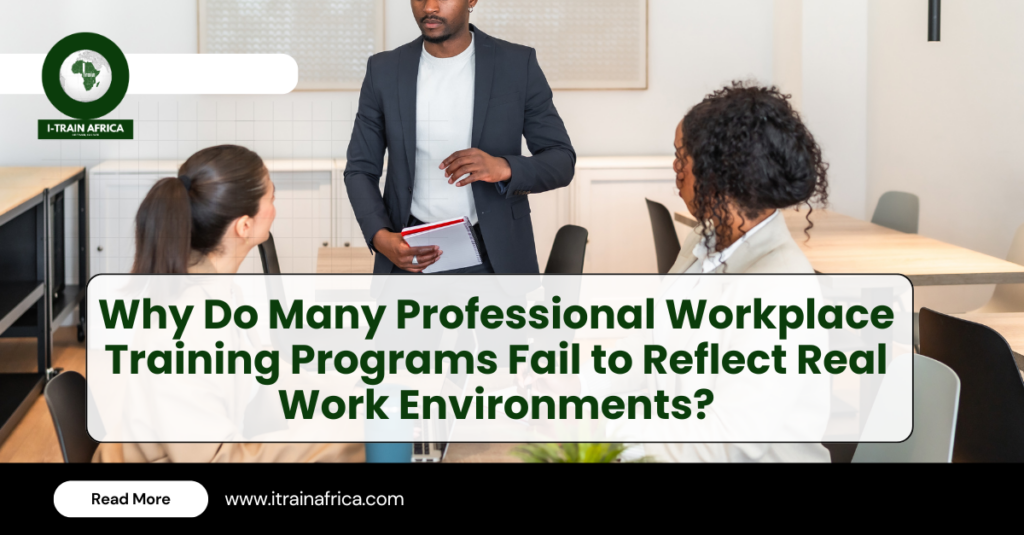
Many professional workplace training programs focus heavily on knowledge transfer but struggle to prepare learners for the realities of modern work environments. A major challenge in workforce development is not simply helping people acquire information. The bigger challenge is helping people apply knowledge effectively in real workplaces. This reality has shaped how many modern workplace […]
6 Workplace Competence Training Skills Employers Look For in 2026
The labour market is changing rapidly, driven by workplace competence training. Employers today are not simply looking for qualifications, certificates, or years of experience. Increasingly, they are looking for individuals who can enter a workplace, contribute value, and perform effectively within modern work systems. This is where workplace competence training becomes important. Many training programmes […]
Why Is Workplace Productivity Training Essential for Closing the Education-Industry Gap?
Across Africa and globally in the labour market, Workplace Productivity training is essential to close the Education-Industry Gap. This is the reason why employers will continue to report a growing disconnect between education and workplace performance. Graduates leave educational institutions with qualifications, yet many organisations still struggle to find talent that can immediately function effectively […]
5 Reasons a Workplace Readiness Curriculum Must Continuously Evolve in an AI-Enabled Workforce Economy
A workplace readiness curriculum can no longer remain static in a workforce environment that is changing faster than ever before. Artificial intelligence is transforming how work is performed. Digital collaboration is redefining communication. Employers are increasingly prioritising adaptability, critical thinking, digital execution, and workplace problem-solving skills. As a result, workforce development programmes must evolve continuously […]
Why Workplace Readiness Training Matters More Than Ever?
Workplace readiness training has become one of the most important conversations in workforce development today. Across industries, employers continue to report a growing disconnect between what people learn and how effectively they perform once they enter the workplace. While many individuals possess academic knowledge, technical qualifications, and professional certifications, workplace execution often reveals gaps that […]