
I was watching Muinat lead a departmental meeting recently.
Clear structure.
Strategic thinking.
Defined outputs.
Precise documentation.
Zero confusion about ownership.
Four years ago, this same young woman was a graduate of Microbiology from the University of Lagos with a 2.1. Intelligent. Disciplined. Serious.
Yet for two years after graduation, she struggled to secure a decent role.
Not because she lacked knowledge.
Not because she lacked a degree.
But because she did not yet possess the digital execution discipline today’s workplaces expect.
Her mentor, who is my friend, referred her to me for an internship to upskill.
Within two months of structured workplace training, her productivity shifted noticeably.
She could function in a digital-first environment through the use of collaborative tools.
Today she leads a department and serves as our Relationship Manager at I-Train Africa
Her degree was not the problem.
The missing layer was employability alignment.
Her degree did not align with the needs of the workforce.
And this is where I believe Africa’s education conversation must evolve.
According to the World Bank, Sub-Saharan Africa must create over 20 million jobs annually by 2030 to absorb new labour market entrants.
At the same time, the African Development Bank reports that more than 60% of employers struggle to find candidates with job-ready skills.
Ironical, right?
This irony irked me so badly five years ago that it led me to build what was missing: the Workplace Fundamental Skills adaptive curriculum that has now reached 13,500+ Africans from 36 countries.
Technology shifts every 18 to 24 months.
AI has redefined documentation, reporting, and collaboration standards in less than three years.
Digital execution expectations are now global.
Yet most degree programmes were designed for a pre-AI, pre-remote, pre-digital collaboration era.
As someone who taught at university level for two years, I deeply respect academic institutions. They build intellectual depth.
But employability today requires an additional performance layer:
• Digital execution fluency
• Structured reporting competence
• Cross-functional collaboration discipline
• Responsible AI productivity
• Task ownership clarity
These are not replacements for degrees.
They are multipliers of degrees.
If Africa wants to convert its demographic growth into economic power, universities and workforce systems must work in partnership.
Not in silos.
The question is no longer:
How many graduates did we produce?
It is:
How productive are those graduates within 90 days of employment?
That is where the real education reform conversation should begin.
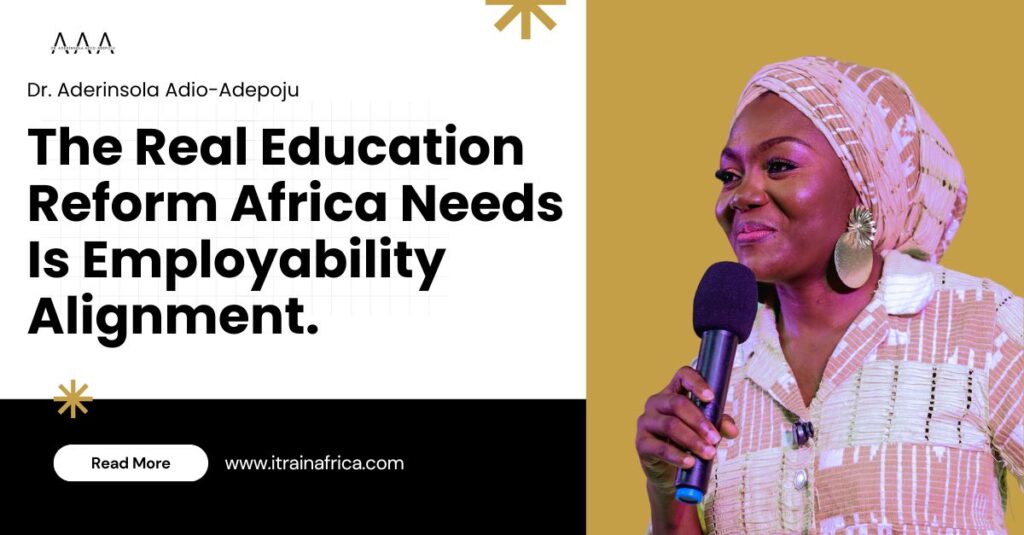
Aderinsola Adio-Adepoju PhD
Global Employability Strategist | Innovation & Workforce Systems Architect | Global Opportunities Expert