
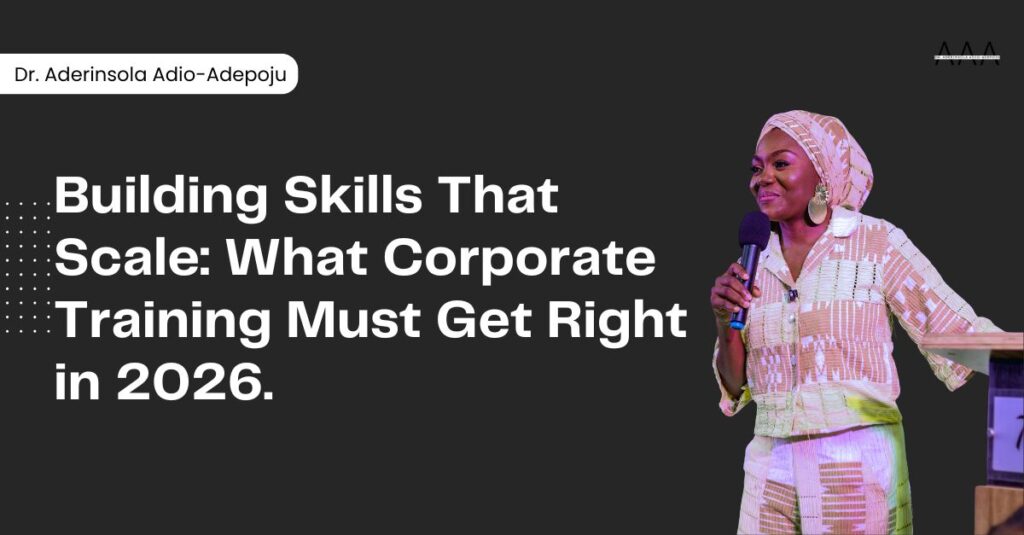
For years, I thought great training was about content.
Better slides.
Smarter facilitators.
More practical examples.
And while all of that matters, here’s what building I-Train Africa has taught me the hard way:
Training does not fail because people don’t learn.
It fails because organisations don’t build a structure around what people learn.
This realisation didn’t come from theory.
It came from lived experience, inside my own company.
When Skills Are Taught but Performance Still Breaks
Last year, as our team grew quickly, I noticed a pattern during appraisals.
People were capable.
They were committed.
They were learning.
But delivery was inconsistent.
Not because they lacked effort, but because:
- Expectations weren’t always interpreted the same way
- Reporting styles differed across teams
- Dependencies between roles weren’t always clear
- Good work wasn’t always translating into measurable outcomes
This was uncomfortable to admit.
Because we already had:
- Job descriptions
- KPIs
- Reporting templates
- Regular performance reviews
We weren’t “unstructured.”
But we had outgrown the version of structure that worked before.
That’s when it became clear to me:
Growth doesn’t break systems.
Scale exposes whether they were designed to scale in the first place.
Why I Personally Rebuilt Our Systems
At this stage, this wasn’t something I could hand off.
We were hiring leadership and managerial roles.
Some of them would report directly to me.
This was no longer operational work; it was vision-level design.
So I rolled up my sleeves.
I redesigned every role, not in isolation, but department by department, so interdependencies were visible.
I broke departments into functional units.
I created eight different playbooks across those units.
What began as a review became a full structural rebuild.
Today, that work lives inside what my team now calls our Success Kit:
- Clear role clarity across departments
- Weekly, monthly, quarterly, and annual reporting templates
- KPIs tied to outcomes, not activity
- Structures for roles we haven’t hired yet
- And yes, a structure for me as CEO too
Because leadership without structure becomes guesswork.
This process took weeks.
It was mentally demanding.
But it transformed execution.
And that experience reshaped how I think about training, especially corporate training.
The Real Problem With Most Corporate Training
Here’s what I see often when organisations invest in training:
- Employees attend sessions
- Skills improve in isolation
- Motivation spikes temporarily
- And then… reality returns
Why?
Because training is introduced without systems to absorb it.
You can teach:
- Communication
- Digital tools
- Project management
- Leadership skills
But if:
- Reporting lines are unclear
- Decision rights are fuzzy
- Expectations aren’t standardised
- Managers aren’t aligned
Then the skills stay theoretical.
And people get blamed for system failures.
What Effective Corporate Training Actually Requires
From building an academy, running a growing company, and training thousands of Africans across different contexts, here’s what I believe works:
1. Training must align with real workflows
Not generic examples.
Not imported frameworks.
But how work actually happens in that organisation.
2. Skills must connect to structure
Learning should map directly into:
- Roles
- KPIs
- Reporting expectations
- Decision-making authority
3. Digital skills are foundational, not optional
Every modern role requires fluency in:
- Collaboration tools
- Digital documentation
- Structured communication
- Data awareness
These are no longer “tech roles.”
They are workplace roles.
4. Global standards matter, even for local teams
Whether staff work locally or remotely, global employability standards are shaping expectations:
- Communication quality
- Output clarity
- Speed and accountability
Organisations that ignore this fall behind quietly.
Why This Matters for Africa’s Workforce
At I-Train Africa, our work sits at the intersection of:
- Employability skills
- Global opportunities
- Workforce readiness
- Institutional capacity building
We’ve seen firsthand that:
- Talent is not the problem
- Motivation is not the problem
- Structure is often the missing link
This is why our approach has evolved beyond training delivery.
We design structured pathways:
- For individuals navigating modern work
- For organisations building performance capacity
- For institutions preparing people for global standards
Training alone is not the solution.
Training embedded into systems is.
A Question for Leaders and Organisations
If your team doubles in the next 12 months:
- Would your systems hold?
- Would expectations stay clear?
- Would performance improve, or become harder to manage?
And when performance dips:
- Do you first look at people…
- Or at structure?
This is the work I’m deeply invested in now.
Quiet work.
Serious work.
Long-term work.
And it’s shaping how we approach corporate training, workforce development, and leadership in 2026 and beyond.
If you’re an organisation thinking about:
- Corporate training
- Workforce readiness
- Digital skills development
- Employability and performance systems
This conversation matters.
Because skills are powerful.
But skills that scale require structure.